
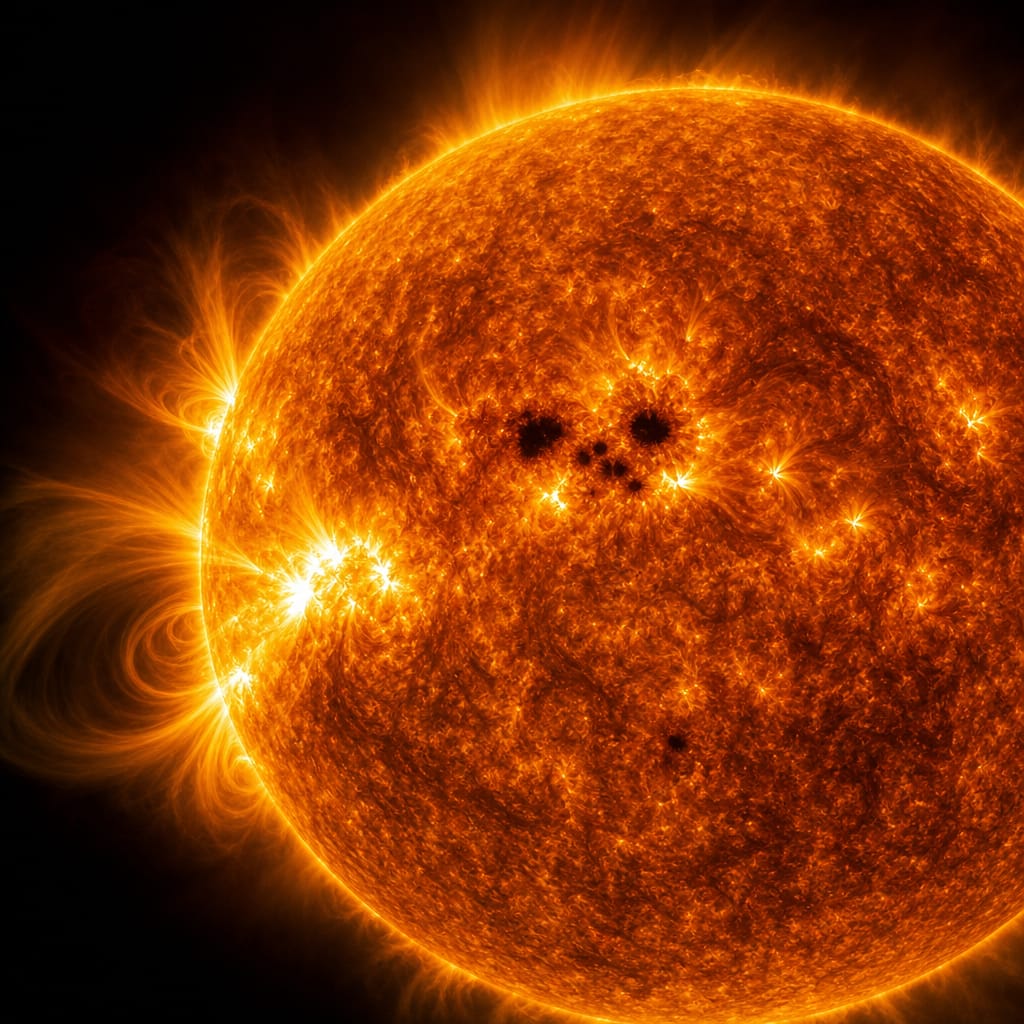

Somewhere between "big yellow thing, keeps us warm, don't stare at it" and "incomprehensibly violent nuclear furnace", there is a more interesting version of the sun that most people never quite get around to thinking about. It is not a constant. It is not a fixture. It is, in the politest possible scientific sense, a bit temperamental.
Solar Minimum and Solar Maximum
Every eleven years or so, the sun swings between two very different versions of itself. Solar Minimum is the quiet phase – fewer sunspots, calmer magnetic fields, the sun sitting there looking serene. Solar Maximum is the other thing entirely: sunspots multiply and cluster, enormous loops of plasma arc off the surface and occasionally snap, firing billion-tonne clouds of charged particles out into space at a million miles an hour. The technical name is a Coronal Mass Ejection, which sounds like something a management consultant would call resigning, but is in fact the sun having what can only be described as an episode.
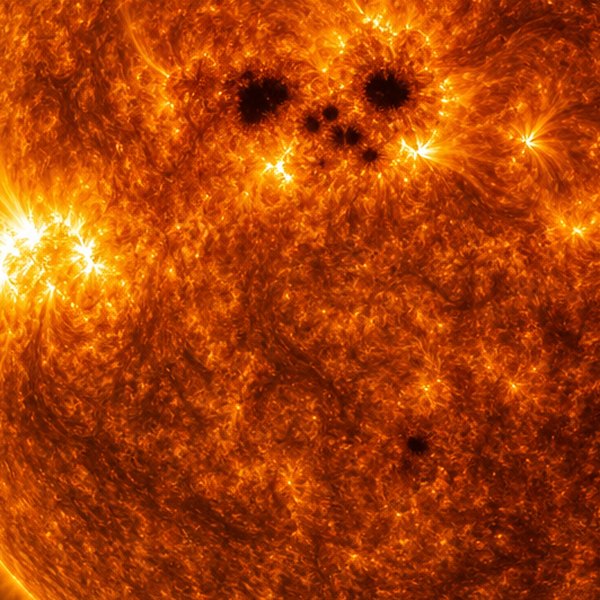
Right now, in 2025, we are right in the thick of one. Solar Maximum arrived earlier and angrier than scientists expected, making this the most active solar period in roughly two decades. If you noticed the Northern Lights showing up somewhere they had absolutely no business being – Cornwall, London, the south of France – that was this. A solar storm in May 2024 pushed auroras further towards the equator than they had appeared in twenty years.
Does It Matter on the Ground?
Which raises the obvious question: does any of this actually matter to someone standing in a Tesco car park?
What a Coronal Mass Ejection Does
More than you might think. When a Coronal Mass Ejection hits Earth's magnetic field, it compresses and distorts it. Satellites wobble in unexpected ways. GPS can drift by metres. Radio communications, especially at high frequencies used by pilots over polar routes, can cut out entirely. During a large storm, satellites in low orbit experience increased drag because the upper atmosphere briefly puffs outward with the extra energy – which is a wonderful image, the sky taking a deep breath – and this has actually caused satellites to lose altitude faster than expected. SpaceX lost 38 Starlink satellites to exactly this in 2022.
Can a solar storm knock out the National Grid?
The electrical grid is the other worry. In 1989, a solar storm knocked out power across the whole of Quebec for nine hours, and the Carrington Event of 1859, still the most powerful storm on record, would cause damage to infrastructure that engineers prefer not to quantify publicly if it happened today. The numbers get slightly apocalyptic. The sun knows nothing of this. It is simply doing what it always does on its little eleven-year schedule, absolutely indifferent to whether we remembered to charge our phones.
We are probably a year or two from the cycle tipping back toward Minimum. In the meantime, the sky above you is a good deal livelier than it looks.
Questions this raises
- When is the next solar maximum due?
- How do solar storms affect satellites and power grids?
- Why is the cycle roughly eleven years long?