


Nobody walks into a freshly painted room and says, "Oh, look at those skirting boards." They say the colour is lovely, or the floor looks new, or the light is nice at this time of day. The skirting board has heard none of it. It just gets on with the job.
And what a job it is. That strip of painted wood or MDF running along the base of your walls is doing at least three things simultaneously – none of which have anything to do with looking pretty – and it's been doing them quietly since roughly the Georgian era without a word of thanks.
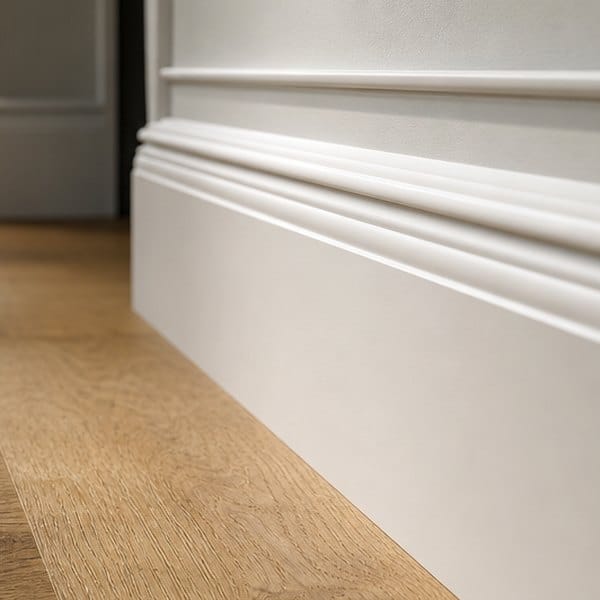
The Structural Problem It Solves
Start with the structural problem it's actually solving. When builders put up walls, they're not joined to the floor. They stop short of it, on purpose, because houses move. Foundations shift fractionally with seasons, floors expand and contract with temperature, and if the plaster ran all the way down to meet the floorboards, that movement would crack it within a year or two. The skirting board is the cover story for this unavoidable gap – the polite fiction that everything meets cleanly when actually, behind that painted face, there is a deliberate void.
Then the Protection Job
Then there is the protection job. Hoover heads, the legs of sofas being shuffled an inch to the left, small children who treat every wall as a crash mat. Without skirting, the base of your plaster would be a spectacular mess. The board takes the hit instead and can be repainted or replaced far more cheaply. It is, in this sense, a sacrificial decoy.
And What Runs Behind It
And then there is what's running behind it. Pull off a length of skirting in most British homes built or renovated in the last forty years and you'll often find pipes, cabling, or both, tucked neatly into the space the board provides. A whole infrastructure, invisible and humming away.
This is what gives skirting boards their quietly interesting quality. The surface is completely unremarkable – white gloss, maybe magnolia if someone was feeling adventurous – but the work being done beneath that surface is surprisingly complex. There's a useful economic comparison in there somewhere, about how the things that do the most invisible structural work rarely get the credit while the visible layer on top takes all the attention. Inflation is a bit like this too. The word floats around news programmes sounding like a simple number, when it's managing a far stranger set of forces underneath. When the Sun Gave Economics Its Favourite Word.
What height should skirting boards be in a modern house?
Back to the skirting board, which deserves its moment. The height of it is even a clue to when your house was built. Victorian and Edwardian skirting runs tall – sometimes 15 to 20 centimetres – because it followed room proportions and, frankly, because it was showing off. Post-war and modern homes often have a mean little strip of five centimetres, the architectural equivalent of a mumbled apology.
It says quite a lot about a house, this small, ignored piece of trim. It knows where the pipes go, remembers every dropped box and slid chair, and it's holding the wall's secret together.
Questions this raises
- Why do skirting boards crack away from the wall?
- Do you fit skirting before or after the flooring?
- Can you paint skirting the same colour as the walls?