

Gold doesn't need a certificate. It sits there being gold, indifferent to what anyone thinks about it. Property is bricks and location and land. You can test either of them chemically, structurally, physically, and the answer doesn't change because a committee reconvened.
Art has one catastrophic vulnerability that nothing else in the inflation-hedge toolkit shares.
The Committee That Shrank Rembrandt
In 1968, a group of Dutch scholars started the Rembrandt Research Project. They methodically and slightly devastatingly went through all the paintings of Rembrandt that up till then had been attributed to him. X-rays, dendrochronology (dating oak panels by counting the tree rings in them to see if the wood had even existed in Rembrandt's lifetime), analysis of pigments used, archives. The complete scholar’s toolkit.
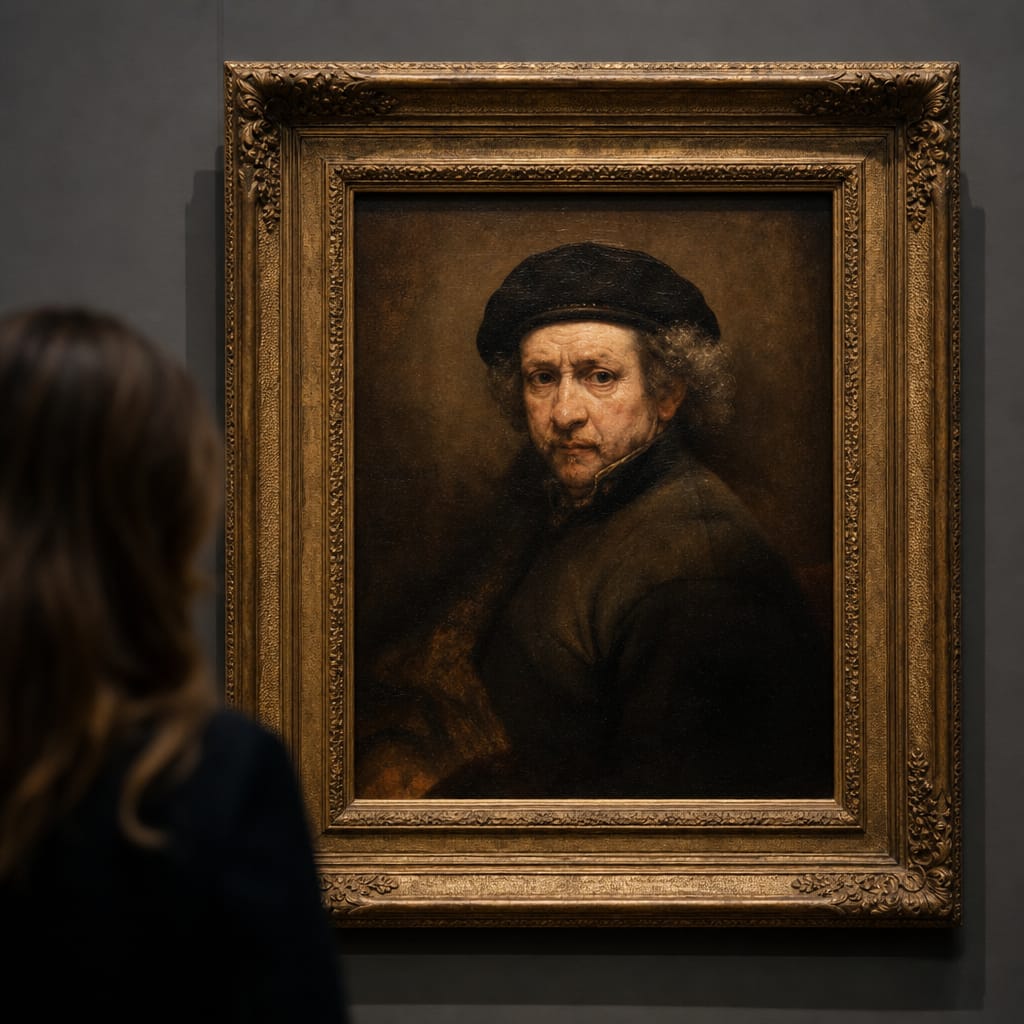
Decades went by in which dozens of paintings which had been in major collections for three hundred years, had been sold at auction for serious money, and were described in catalogues as having been painted by Rembrandt, were quietly reclassified as having been painted by the ‘workshop of Rembrandt’. The canvas, brushstrokes and frame of the pictures all remained the same, as did the wall, but the label was different.
The financial consequences could be severe. A confirmed Rembrandt and a "follower of Rembrandt" are not the same conversation at auction. In the worst cases, attribution collapse can strip away 80 or 90 percent of a valuation on an object that hasn't changed by a single atom.
The Claim Is the Asset
Art makes a peculiar store of value. Typically people consider what their money should be doing, how old they should be before work stops owning them, and what kinds of assets they should hold (at the high end of the market, typically art). But few consider the risk of mis-attributing a work of art.
With other tangible assets, such as gold or property, their value is tied up in the physical object itself. You can’t X-ray a gold bar to discover it is in fact ‘workshop of gold’, nor does a property lose three-quarters of its value when someone publishes a paper on who built it.
With art, the physical object itself can cost a few hundred pounds to create. The rest is attribution – the story of who made it with their hands. ‘Rembrandt’ as opposed to ‘attributed to Rembrandt’ as opposed to ‘circle of Rembrandt’ is not a footnote in a catalogue. It is the entire financial calculation.
The Expert Consensus Is Not Fixed
The stranger thing about this is that the attribution is not even stable. The Rembrandt Research Project has in the course of time re-evaluated parts of its research and occasionally reinstated works it had reclassified downwards. The committee is the market and committees change their minds.
A dendrochronology result is one piece of information: if the panel is oak felled after Rembrandt's death, the question is settled. However, there is no test to verify whether a specific hand painted a specific work in a specific room. All the financial risk lies within this gap.
Frequently asked questions
Can't modern technology settle an attribution for good?
Not quite. Infrared reflectography, isotope analysis and X-ray fluorescence are powerful for ruling out possibilities: wrong pigment for the era, wood from the wrong date etc. But establishing the hand of a particular artist is outside the capabilities of these methods. Attribution is ultimately a matter of human judgement, which is decided by consensus and thus can change.
Does this only happen to old masters?
Old masters are the most dramatic example because the sums are biggest, but no. Forgery scandals and catalogue raisonné disputes have disrupted markets for 20th-century artists and even some still-living ones. The closer you get to Rembrandt-scale prices, the bigger the potential drop when attribution wobbles.
If a major museum holds a work as a Rembrandt, is that a financial guarantee?
A strong signal, not a guarantee. Several works in prominent collections have had their attributions revised – sometimes by the museums themselves. Institutional backing is the best case you can make for a painting, but it is still a claim, not a chemical property.
What does "workshop of" mean?
Typically these paintings were executed in the master’s studio. They could have been executed to the master’s design, with the master’s possible participation. In most cases, however, the majority of the painting would not have been executed by the master’s own hand. In art history terms, these paintings are still significant pieces of their period. In financial terms, however, it can be the difference between a potentially life-changing sum of money and a merely comfortable sum of money.