


Before anyone had heard of shareholder agreements, profit-sharing schemes, or a vote of no confidence, a collection of sunburned criminals on a leaking wooden ship in the Caribbean had quietly invented all three.
Pirate Ships Were Not Chaos
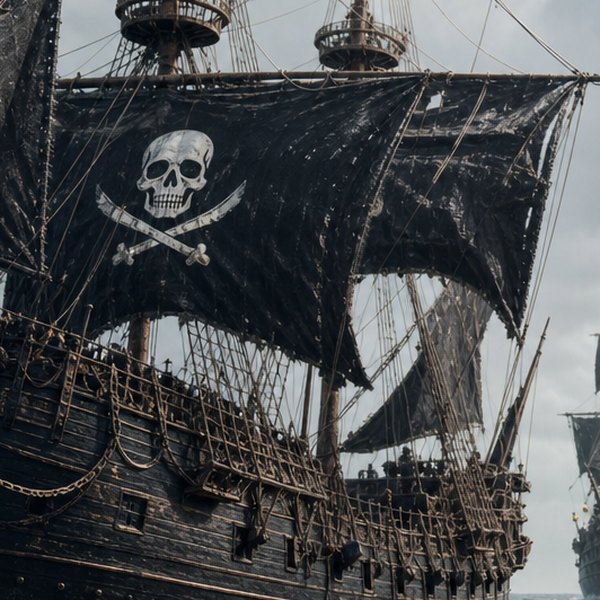
Pirate ships in the golden age of piracy – roughly 1650 to 1730 – were not the chaotic floating dictatorships the films enjoy. They were, by most historical measures, extraordinarily well-governed workplaces. Captains were elected and could be voted out. Prize money – whatever the ship seized – was divided according to a written contract called the ship's articles, which every crew member signed before the voyage departed.
How was injury compensation worked out on a pirate ship?
If you were injured in the line of duty, the articles specified your compensation: lose a right arm, receive a set number of pieces of eight. Lose an eye, receive fewer. Brutal, specific, and entirely contractual.
Sound familiar? It should. Strip the cutlasses and the scurvy away and what you have is something very close to a small limited company with a profit-share scheme, a board that can remove the chief executive, and employment contracts signed on day one.
The Captain Did Not Get Everything
The captain, notably, did not automatically get everything. On most pirate vessels the captain received a larger share of the prize – often two shares to an ordinary sailor's one – but not by much. The quartermaster, who managed the ship's internal affairs and kept order on deck, typically earned the same as the captain. That's your operations director, in effect. The captain held total authority only in battle. The rest of the time he was accountable to the crew, who could and did hold votes and remove captains they found wanting. Bartholomew Roberts, one of the most successful pirates of the era, sailed under articles that explicitly limited what the captain could eat and drink relative to the crew. Even the chief executive had his expenses monitored.
Why were pirate crews so democratic?
What is genuinely striking is *why* pirate ships ended up this way. It was not idealism. These were pragmatic people in a high-risk, low-trust industry where your colleagues were strangers and your employer was, technically, nobody. With no legal system to appeal to and no way to enforce agreements by any external authority, the crew had to design their own governance from scratch. Accountability was baked in because the alternative – a captain who kept most of the prize and faced no consequences – would simply have been abandoned or thrown overboard.
That is, in a slightly less murdery way, exactly what governance documents, shareholder agreements, and profit-sharing structures are for in an ordinary business. They exist precisely because trust alone is not a system. You write things down. You specify who decides what. You agree in advance what happens when it goes wrong.
The pirates figured this out by necessity. Most small businesses figure it out only after something has already gone wrong.
Questions this raises
- Do any original pirate articles still survive?
- What happened to a captain who was voted out?