
There is a fresco in a church in Germany from the thirteenth century. The Virgin Mary's robes are the most astonishing blue you have ever seen – a deep, almost liquid blue that seems to pull light into itself rather than reflect it. It cost the church a fortune. Not the whole fresco. Just the blue.
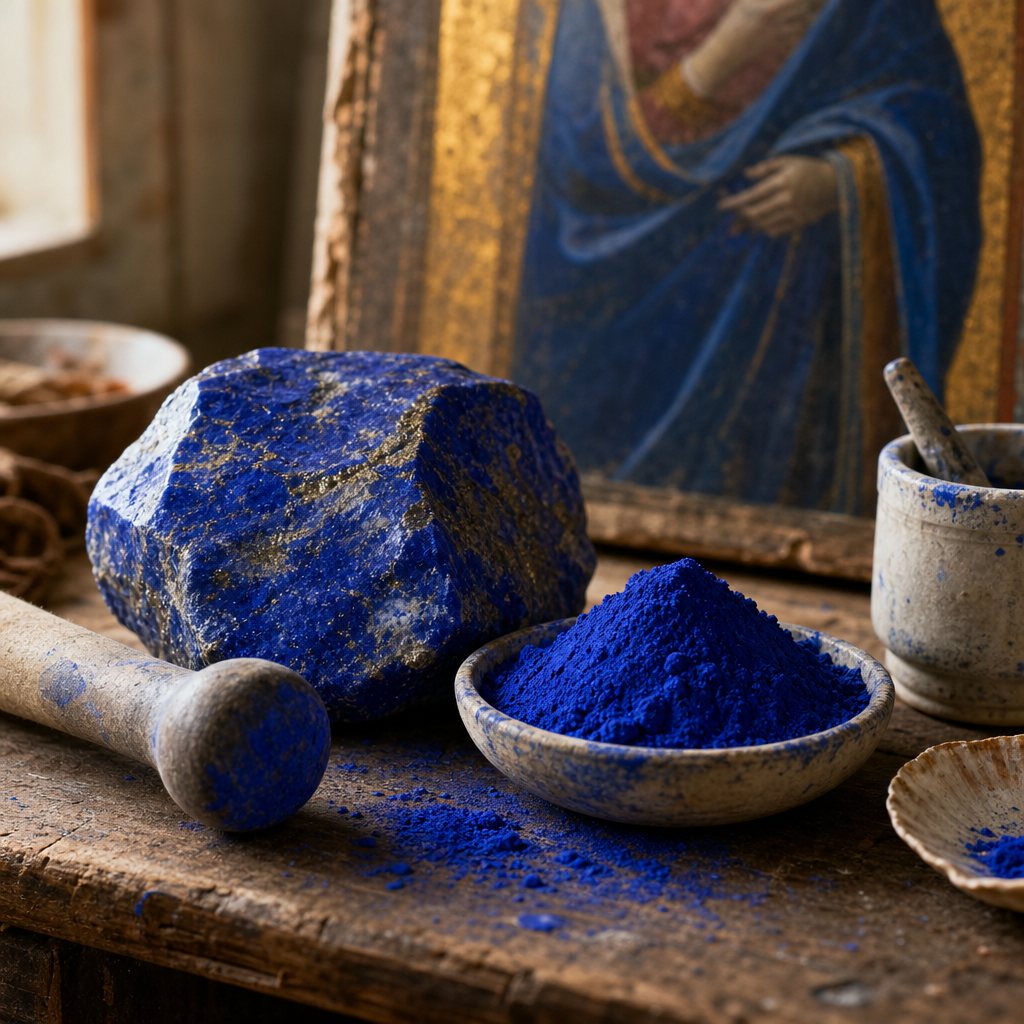
That colour was ultramarine, and it came from a single source on earth: the lapis lazuli mines of Badakhshan, in what is now north-eastern Afghanistan. The stone was dug out, crushed, washed, and then shipped – overland by donkey and camel, then by sea – thousands of miles to the workshops of Venice and Florence. There it was finally ground into pigment. By the time it reached a painter's palette in Cologne or Bruges, it had crossed half the known world and changed hands perhaps a dozen times. Every hand in that chain took their cut.
From mountain to mortar
These mines are located at Sar-e-Sang in the Kokcha valley and are still worked today. Lapis from them has been traded for thousands of years, long before European painters had need of it. To extract a usable blue from the stone is in itself a difficult process. Lapis is a mixture in which the blue mineral lazurite sits in a matrix of calcite (a grey stone) and pyrite (a glittering stone). Simply grinding the lapis down results in a dull greyish powder. The Italian painter Cennino Cennini in his handbook from around 1400 described the method of extracting blue from lapis in the following way: first the lapis was ground up, then mixed with wax, resins and oil to form a dough. This was left to stand for days and then kneaded under a solution of lye. Gradually the blue particles would be washed out of the stone, leaving the grey calcite behind as waste. The first extraction resulted in the richest blue, subsequent ones in paler blues that were sold at a lower price.
Rationing the blue
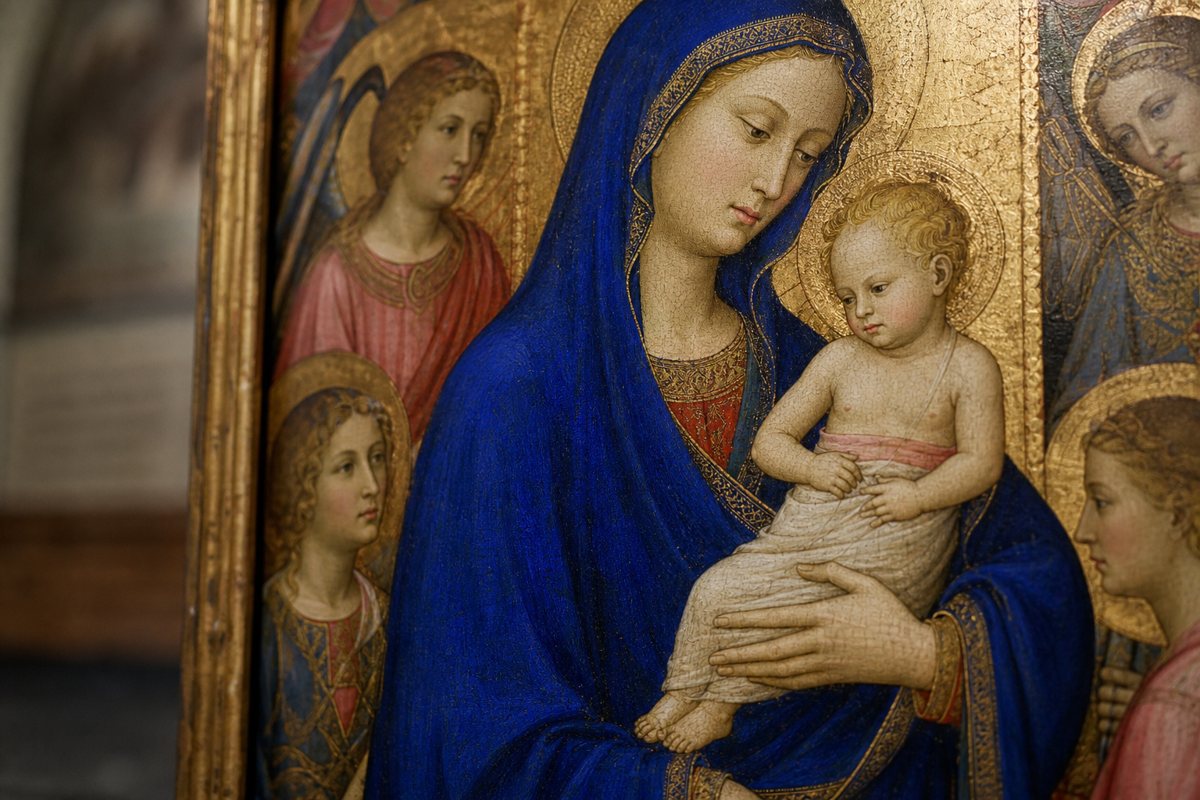
The result was a colour so expensive that painters could not simply buy it and use it freely. The contracts between artists and their patrons – yes, actual written contracts – would specify exactly how many ounces of ultramarine would appear in the finished painting. Blue robes for the Virgin were a theological statement, certainly, but they were also a financial one. The patron was showing the church, and the neighbourhood, what they had spent.
The cost of pigment to the artist was so high that it was often the patron who bought the paint, sometimes handing it to the artist directly so that no cheaper blue could be swapped in. The artist’s contract might name not only the amount of paint in ounces to be used but also which figures, such as the Virgin, were to be painted with ultramarine and which with a less expensive variety, such as copper-based azurite, used for lesser saints and background figures. Where the money ran short he may have had to make do by using the expensive pigment on the lit folds of robes and the cheaper in the shadows, ultramarine and azurite respectively, a compromise that can sometimes still be seen.
When stocks of paints were low, painters tried to make them last as long as possible. So a layer of cheap blue paint could be painted over with a thin layer of ultramarine, or the pigment diluted until it was paler and greyer than the customer had hoped. The painter would have lost a lot of money if the patron who had specified ultramarine for his painting could not or would not pay for enough of it and he had to make up the difference with his own money. In small workshops this could have caused great losses.
Why the cheaper blues let painters down
A number of blues were available in Europe but none of them were of good enough quality. Azurite was the painters’ principal blue. It has a tendency to change slowly to green and transform into malachite, which is one reason some medieval skies and robes now look murky. Other blues such as smalt, a powdered cobalt glass, would change colour when used in oil painting. Indigo, a good blue for cloth, was not suitable for use in panel paintings. The solution to this problem had been found by the Egyptians thousands of years before. They used a pigment called Egyptian blue, which was made by heating sand with a copper compound and lime. It was used from circa 3100 BC in Egyptian art, and was also used by the Greeks and Romans, but it was largely abandoned by European artists. The result was that many painters did not attempt to paint blue skies and set their figures against gold leaf instead.
Scarcity, distance and every pair of hands
This is worth sitting with for a moment, because it is so easy to think of inflation as a modern affliction. Something that arrived with fiat money or central banks or supermarket price stickers changing overnight. But the medieval painter negotiating his blue by weight was experiencing something entirely familiar: the cost of scarcity, multiplied by the cost of distance, multiplied by the cost of every pair of hands along the way. Supply chains, essentially. The same forces that multiplied the cost of shipping a container from China to Europe during 2021 are the forces that made ultramarine worth more than gold leaf by the ounce.
Which is why, when a synthetic alternative (French ultramarine) arrived in the late 1820s, the price collapsed almost immediately. The colour did not change – the sky-blue of the Virgin's robe was exactly the same shade. But once scarcity disappeared from the equation, so did most of the price. That is not a financial abstraction. It is pigment on a chapel wall making the point more vividly than a textbook graph ever could.
How chemistry ended the scarcity
The first crack in blue’s scarcity came in Berlin in 1704, when a colour-maker (usually named as Johann Jacob Diesbach) tried to create a red but it went blue instead. He had used contaminated ingredients and made a very intense blue which was called Prussian blue. The cheap, strong and stable colour was quickly taken up and the Great Wave off Kanagawa by Katsushika Hokusai was printed in the early 1830s using this new colour.
Artificial ultramarine was attempted next. In France, the offer of a prize in 1824 by Société d’Encouragement pour l’Industrie Nationale for a way of making ultramarine artificially led to the prize being claimed by Jean-Baptiste Guimet in 1828, though there are claims that he had produced the pigment as early as 1826. Another chemist, Christian Gmelin, a German, also published a method of producing ultramarine around the same time. Synthetic ultramarine was made by heating a mixture of clay, soda, sulphur and charcoal. It was of the same colour as the naturally occurring pigment but at a minute fraction of the price. Within a generation ultramarine had moved from being used in paintings of altarpieces to being used on wallpapers, house paint and even in laundry blue to make white things whiter. The Impressionists could afford to use lots of blue for shadows as well as for general colour.
The mechanism never changes
Inflation has always been, at root, a story about stuff: where it comes from, how far it has to travel, and how many people had to touch it first. The prices change. The mechanism never really does.
Questions this raises
- Who paid for the pigment, the painter or the patron?
- Did contracts specify how much ultramarine to use?
- Are the Badakhshan mines still producing lapis lazuli?
- How can you tell real ultramarine from a substitute?