

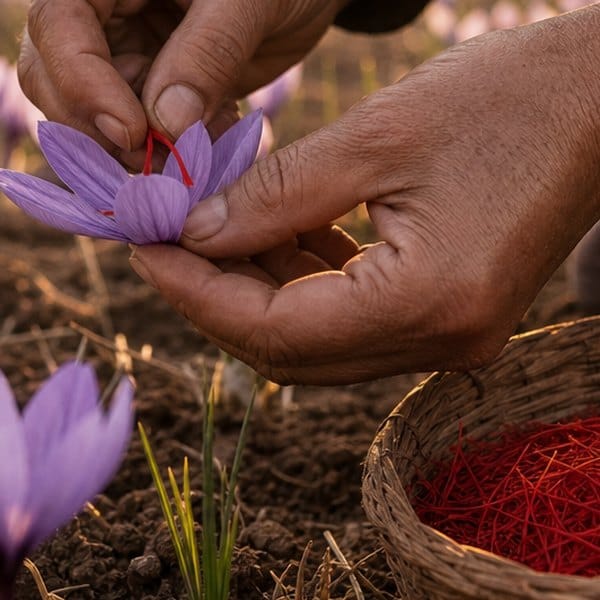
Somewhere in Spain or Iran or Kashmir right now, a person is crouching in a crocus field at dawn, before the flowers close, picking each bloom by hand, then pinching out three tiny red threads from the centre of each one. A single kilogram of saffron requires roughly 150,000 flowers. That is not a typo. One hundred and fifty thousand individual crocuses, each harvested by hand, each stripped of its three stamens before the petals wilt.
Worth More Than Gold by Weight
Which is why saffron has always cost roughly the same as a bad decision, and why medieval Europe treated it less like a spice and more like a controlled substance.
At its peak, saffron was worth more than gold by weight. Traders transported it under armed guard, and Italian merchants kept it in locked strongrooms alongside silver and silk. The fraud was, inevitably, spectacular.
How the Counterfeiters Worked
Counterfeiters would bulk out genuine saffron with safflower petals, marigold threads, even strands of beef, dyed yellow and dried. The colour was right. The smell was not quite right. But by the time anyone noticed, the merchant was three towns away. Medieval Germany took a particularly dim view of this. Under the Safranschou laws in Nuremberg, convicted saffron adulterers were burned alive, often alongside their fake product, which is one way to make a point about trading standards. A few were buried alive instead, presumably for variety.
The sentences were not metaphorical. The authorities genuinely believed that if the punishment was dramatic enough, the fraud would stop. (It did not stop. It has never stopped. Even today, Spanish saffron labels sometimes hide cheaper Iranian product inside.)
The Smuggling Routes
The smuggling routes were their own small thriller. Saffron moved from Persia through Constantinople, across the Mediterranean, up through Italy, and into Northern Europe, with levies extracted at every border crossing and middlemen shaving their percentage off along the way. The final price in London or Paris bore almost no relationship to what a farmer in Khorasan had been paid. This gap – between what something genuinely costs to produce and what the market eventually charges you for it – is one of the oldest stories in economics, and it is still running. The Paint That Cost More Than the Portrait explores exactly the same idea from a different angle, if you want to follow the thread.
Why is saffron still picked entirely by hand?
What makes saffron so persistent as both a luxury and a target for fraud is simple: the labour is genuinely irreplaceable. You cannot mechanise the harvest without destroying the threads. The crocus flowers for one week a year, and the window for picking each bloom is a few hours. No shortcut exists, which means the price is not artificial. It reflects something real – thousands of hours of skilled, careful, repetitive human work compressed into a small glass jar on a supermarket shelf for about £8.
That jar took more effort per gram than almost anything else you will ever cook with. It deserves a better fate than a risotto you made on a Tuesday without really thinking about it.
Questions this raises
- How do you tell real saffron from fake?
- Which country produces the most saffron today?
- Does saffron grown in Britain taste different?